

Cilantro Benefits: What It Really Does for Your Health
Table of Contents
- Key Takeaways
- What Is Cilantro?
- Cilantro Nutrition at a Glance
- Cilantro in Functional Nutrition
- Blood Sugar Regulation
- Cardiovascular Health
- Antioxidant and Anti-Inflammatory Properties
- Digestive Function
- Antimicrobial Activity
- Brain Health
- Liver Health and Detoxification
- How to Use Cilantro in a Healthy Diet
- FAQ
- The Bottom Line on Cilantro
Key Takeaways
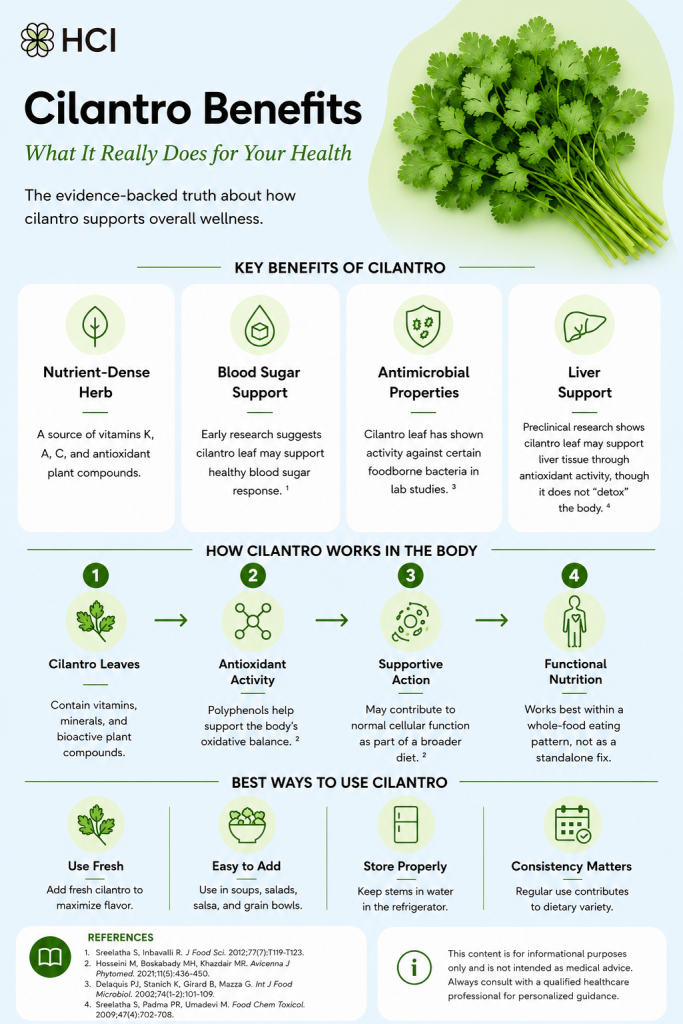
- Cilantro is a nutrient-dense herb rich in vitamin K, vitamin A, and antioxidants
- Supports digestive, cardiovascular, and metabolic health within a broader dietary pattern
- Most research is early-stage, and findings should be interpreted in context
- Cilantro is best understood through a functional nutrition lens: supportive, not therapeutic
- Both raw and cooked cilantro offer nutritional value
Cilantro tends to divide people quickly. You either love it or think it tastes like soap.
Beyond personal preference, it has also gained a reputation in wellness spaces as a “functional” or even medicinal herb.
From a functional nutrition perspective, it’s worth reframing that narrative.
Cilantro is not a therapeutic agent. It does not “detox” the body or act as a standalone intervention. What it does offer is a combination of micronutrients and plant compounds that may contribute to normal physiological processes when included consistently as part of the diet.
Let’s take a closer look at what cilantro does in the body and where the science stands today.
What Is Cilantro?
Cilantro comes from the plant Coriandrum sativum. The leaves and stems are what we call cilantro, while the seeds are known as coriander.
This distinction matters because many people use the terms interchangeably, but they offer slightly different flavors and nutrient profiles.
Cilantro is widely used in cuisines around the world, from Latin American to Southeast Asian dishes, and is increasingly studied for its bioactive plant compounds.
Cilantro Nutrition at a Glance
Even in small amounts, cilantro contributes meaningful nutrients:
- Vitamin K – important for bone health and blood clotting
- Vitamin A – supports immune and eye health
- Vitamin C – antioxidant support
- Polyphenols – plant compounds that help reduce oxidative stress
While herbs are used in small quantities, their cumulative intake over time can contribute to overall dietary nutrient diversity.
Cilantro in Functional Nutrition
From a functional nutrition perspective, cilantro is best understood as a supportive food within a dietary pattern, not a standalone driver of physiological change.
It may contribute to:
- Antioxidant intake
- Digestive comfort within traditional food patterns
- Cardiovascular support through nutrient density and sodium displacement
- Dietary diversity of phytochemicals
The key principle here is context: cilantro’s effects are not isolated; they are dependent on the broader diet and lifestyle pattern it sits within.
Cilantro and Blood Sugar Regulation
Some early research suggests cilantro may have a modest effect on blood sugar markers, likely related to its phytochemical content and potential effects on metabolic signaling pathways.¹
Most evidence is preclinical or based on small-scale studies, so conclusions in humans remain limited.
Within a functional nutrition framework, cilantro is not considered a treatment for blood sugar dysregulation. However, it may be part of a dietary pattern that supports metabolic health alongside fiber-rich, minimally processed foods.
Cilantro and Cardiovascular Health
Cilantro may play an indirect role in cardiovascular health through several mechanisms:²
- Provides antioxidants that contribute to oxidative stress balance
- Contains potassium, which supports blood pressure regulation
- Adds flavor that may reduce reliance on sodium-heavy seasonings
Cilantro’s role is best understood as supportive within a nutrient-dense dietary pattern.
Antioxidant and Anti-Inflammatory Properties
Antioxidants play a critical role in protecting cells from oxidative stress, a process linked to aging and chronic disease.
Cilantro contains plant compounds that have demonstrated anti-inflammatory and antioxidant activity in experimental research.²
These findings support biological plausibility, but they do not necessarily translate into clinical outcomes when cilantro is consumed in typical dietary amounts.
From a functional nutrition standpoint, this reinforces a broader principle: cellular resilience is influenced by overall dietary pattern, not isolated compounds.
Cilantro and Digestive Function
Cilantro has a long history of use in traditional dietary systems to support digestive comfort.
Commonly reported benefits include:
- Reduced post-meal bloating
- Improved digestive ease
- General gastrointestinal comfort
While these effects are largely based on traditional use and observational experience, cilantro is also commonly consumed alongside whole foods that support gut health, which makes it difficult to isolate its specific contribution.
Antimicrobial Activity (Early Research)
Some early research has explored cilantro’s activity against certain bacteria, including foodborne pathogens.³
These findings are primarily limited to the laboratory and should be interpreted cautiously.
Cilantro is not a substitute for food safety practices or medical treatment. However, it contributes to the broader phytochemical diversity of the diet.
Cilantro and Brain Health
Interest in cilantro’s potential effects on neurological function is emerging due to its antioxidant and phytochemical composition.
Some early research explores possible protective mechanisms related to oxidative stress in neural tissue, but human evidence remains limited.²
At this stage, cilantro is best considered part of a brain-supportive dietary pattern rather than a targeted cognitive intervention.
Cilantro and Liver Health (and Detoxification)
Cilantro is often associated with “detox” and liver health in wellness spaces.
In physiology, detoxification refers to the liver’s highly regulated metabolic and excretory processes that process endogenous and exogenous compounds through enzyme systems.
Some early research has explored antioxidant activity and potential protective effects of cilantro in liver tissue, primarily in preclinical models.⁴
Within this context, cilantro may contribute antioxidant compounds as part of a nutrient-dense dietary pattern that supports normal cellular function.
That said, the liver already has sophisticated detoxification pathways. No single food can enhance, replace, or take over that role.
In functional nutrition, cilantro is best understood as a supportive dietary input within a broader system of nutrition and lifestyle factors that influence physiological resilience.
How to Use Cilantro in a Healthy Diet
Raw and cooked cilantro both offer value.
Raw cilantro preserves more volatile aromatic compounds, while cooked cilantro still contributes micronutrients and flavor complexity to meals.
Cilantro can be included regularly as part of a varied diet. The emphasis, from a functional nutrition perspective, is diversity. No single food is responsible for overall health outcomes.
Individual tolerance also matters. While cilantro is generally well tolerated, preference, digestive sensitivity, and rare food allergies can influence intake.
Practical Ways to Use Cilantro
Simple ways to incorporate cilantro:
- Add to soups, salads, and grain bowls
- Blend into sauces like chimichurri or salsa
- Mix into smoothies or green juices
- Top tacos, rice dishes, or roasted vegetables
Storage tip: Keep cilantro fresh by storing stems in water in the refrigerator, similar to fresh herbs like parsley.
FAQ
Is cilantro better raw or cooked?
Both are beneficial. Raw preserves more volatile compounds, while cooked cilantro still provides nutrients.
Can I eat cilantro every day?
Yes, as part of a balanced dietary pattern.
What organ is cilantro good for?
It may support liver function through antioxidant intake, but it does not act as a detox treatment.⁴
What vitamins are in cilantro?
Primarily vitamin K, vitamin A, and vitamin C.
What are the side effects of cilantro?
Rare, but may include food sensitivity or allergic reactions in some individuals.
The Bottom Line on Cilantro
Cilantro is a great example of how nutrition conversations can sometimes give too much credit to a single food.
It is not a miracle herb, and it does not independently “detox” specific organs or systems. From a functional nutrition perspective, its value comes from what it contributes to the bigger picture: nutrients, beneficial plant compounds, and flavor that can make whole-food eating more enjoyable and sustainable.
The reality is that health outcomes are not driven by individual foods. They are shaped by the patterns, habits, and systems we build consistently over time.
If you find yourself drawn to this kind of evidence-based, whole-systems perspective on nutrition, take a look at HCI’s Functional Nutrition Professional certification.
References
- Sreelatha S, Inbavalli R. Antioxidant, antihyperglycemic, and antihyperlipidemic effects of Coriandrum sativum leaf and stem in alloxan-induced diabetic rats. J Food Sci. 2012;77(7):T119-T123. doi:10.1111/j.1750-3841.2012.02755.x. https://pubmed.ncbi.nlm.nih.gov/22671941/
- Hosseini M, Boskabady MH, Khazdair MR. Neuroprotective effects of Coriandrum sativum and its constituent, linalool: A review. Avicenna J Phytomed. 2021;11(5):436-450. doi:10.22038/AJP.2021.55681.2786. https://pmc.ncbi.nlm.nih.gov/articles/PMC8554282/
- Delaquis PJ, Stanich K, Girard B, Mazza G. Antimicrobial activity of individual and mixed fractions of dill, cilantro, coriander and eucalyptus essential oils. Int J Food Microbiol. 2002;74(1-2):101-109. doi:10.1016/s0168-1605(01)00734-6. https://pubmed.ncbi.nlm.nih.gov/11929164/
- Sreelatha S, Padma PR, Umadevi M. Protective effects of Coriandrum sativum extracts on carbon tetrachloride-induced hepatotoxicity in rats. Food Chem Toxicol. 2009;47(4):702-708. doi:10.1016/j.fct.2008.12.022. https://www.sciencedirect.com/science/article/abs/pii/S0278691508007242

Ready to learn more?
REQUEST INFO
or call 1-800-303-2399